

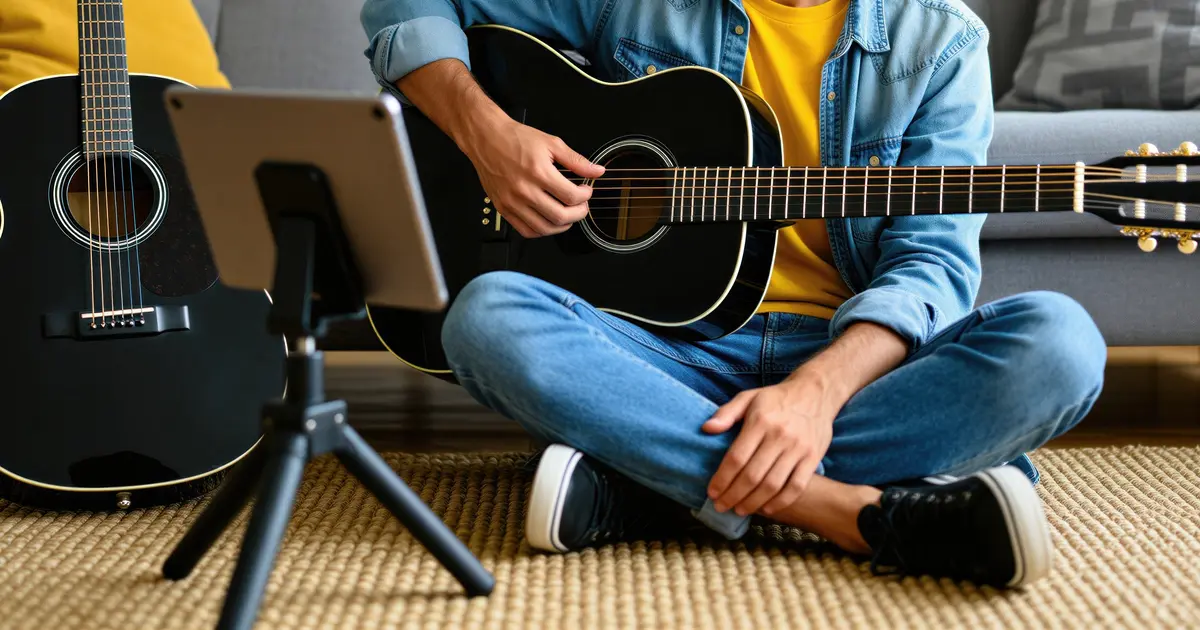
A band splits the problems up. Somebody else holds the tablet, somebody else keeps time, somebody else fills the space between chords with a second instrument. A solo performer is holding the guitar, singing, and reading the words at once, with nobody free to turn a page — which makes a few things matter more here than they do for a band, and a few things stop mattering at all.
What stops mattering: syncing setlists between people, sharing a library, keeping four devices in step. Every feature sold on that basis is worth nothing to one person. What starts mattering is that both of your hands are busy — and that there is nobody to cover the gap while you fix something.
When you need to fill the sound yourself
OnSong. The strongest case for a solo act that runs backing or click tracks: it plays them alongside the sheet, sends MIDI to a looper or drum machine, and takes a wireless foot pedal so your hands never leave the strings to turn a page. Free to build a library in; Essentials $29.99 a year, Premium $59.99 a year for the tracks and MIDI. iPhone, iPad and Mac only. Full comparison.
JustChords. The same idea from a different angle: audio tracks attached from Spotify or Apple Music per song, AUv3 so the whole thing runs as a plugin inside GarageBand or Logic Pro if you are building loops there, and a metronome and tuner already in the app you are reading from — one less thing to dig for between songs. Free, with optional tips. Also iPhone, iPad and Mac only. Full comparison.
When you want to own the app and stay cross-platform
SongBook ChordPro. No subscription, no account required to use what is already on the device, and it runs on Android as well as Apple — the practical choice if a backing rig is not the point and you would rather buy the app once. Bluetooth pedal support and a metronome cover the two things a solo player usually needs the most: hands-free scrolling and a steady click. Full comparison.
When the room is the instrument you are missing
This is the one nobody else on this list does, and it is specific to playing alone: a solo acoustic set often wants the audience singing, and a solo performer has no bandmate to pass lyric sheets around.
Strumfolio. Strum Together turns that into a link. Share it before the song, and anyone in the room — a stranger at an open mic, a table that just sat down, an audience of one at a house concert — follows the same words in the same key on their own phone, with no account, no install, nothing to hand out and collect afterward. It is the closest thing here to a second voice on stage, and it costs the room nothing to use.
For the reading itself: a capo suggestion works out which fret leaves the most open shapes when a song sits better a step or two from where it is written — useful the moment you are re-keying something to fit your own voice rather than the original singer's. That one you can try on your own chords right now, without an account: the capo calculator runs the same arithmetic, and the transposer is the other half of it. The free plan is a real repertoire with no end date, one songbook and thirty songs, which is enough to hold an actual solo set list — and a setlist length calculator for working out whether it fills the slot. How to bring an existing set of chord sheets in covers moving a repertoire over without retyping it.
Worst at: everything the first two apps are built around. No foot pedal, no backing or click tracks, no MIDI, no metronome or tuner. If the act depends on a loop pedal running from the same app that shows the chords, look at OnSong or JustChords instead.
Before any of that: make the page readable
The feature everybody shops for is hands-free page turns. The one that decides whether the evening is comfortable is how big the words are. A phone flat on a table at knee height, in a room lit for atmosphere rather than for reading, is the actual reading condition of most solo gigs — and no pedal fixes text you are squinting at.
So before comparing rigs, settle the boring things: the largest zoom you can still fit a verse into, a stand that puts the screen at eye level rather than on the floor, and the screen kept awake so it does not black out in the middle of a chorus. Auto-scroll matters here too, and for a reason that is easy to miss — a page that scrolls itself at the right speed turns page-turning from an event into something that never happens. Set it once per song and your hands never have to leave the strings at all.
Picking one
- The set runs on backing tracks, a click, or a hardware looper synced by MIDI: OnSong.
- Same idea, but you would rather build it inside GarageBand than pay a yearly rig fee: JustChords.
- You want a metronome and a pedal, bought once, on whatever device you have: SongBook.
- The set is just you, your instrument, and you want the room reading along without printing anything: Strumfolio.
None of these is wrong for a solo act — they are answers to different questions about what "alone on stage" needs help with. If there is a band after all, the six-app round-up is the wider list, and the offline-specific one covers what happens when the venue has no signal either.
Questions people ask
- What app do solo musicians use for lyrics and chords on stage?
- The split is the same as for bands, but the priorities are different. On Apple hardware, OnSong and JustChords are the two with foot pedals, backing tracks and a metronome, which is what a one-person act supplementing itself needs. If you would rather buy once and run on Android too, SongBook ChordPro covers that. If what you want is the audience reading along on their own phones, that is a link-based web app.
- How do I turn pages without stopping playing?
- Two ways, and most solo players end up using both. A foot pedal turns the page without taking a hand off the strings — each of the three apps above supports one in some form, though which kind of pedal differs between them. Auto-scroll moves the sheet continuously at a speed you set per song, so there is no page turn to make at all; that one needs no hardware and works in a browser.
- Can I get the audience singing along without printing lyric sheets?
- Yes, by sharing a link rather than paper. Whoever opens it follows the same song in the same key from their own phone, with no account and nothing to install — which for an open mic or a house concert is the difference between a singalong and a room politely listening. Starting a session is on the paid plans; following one is free for anyone who opens the link.
- Do I need to pay for a chord app to play solo gigs?
- No. JustChords is free with optional tips if you are on Apple devices, and Strumfolio has a free plan with one songbook and thirty songs, which is enough for a working solo set. Paying buys the stage hardware support — pedals, tracks, MIDI — or the caps coming off, rather than the ability to read a chart.