

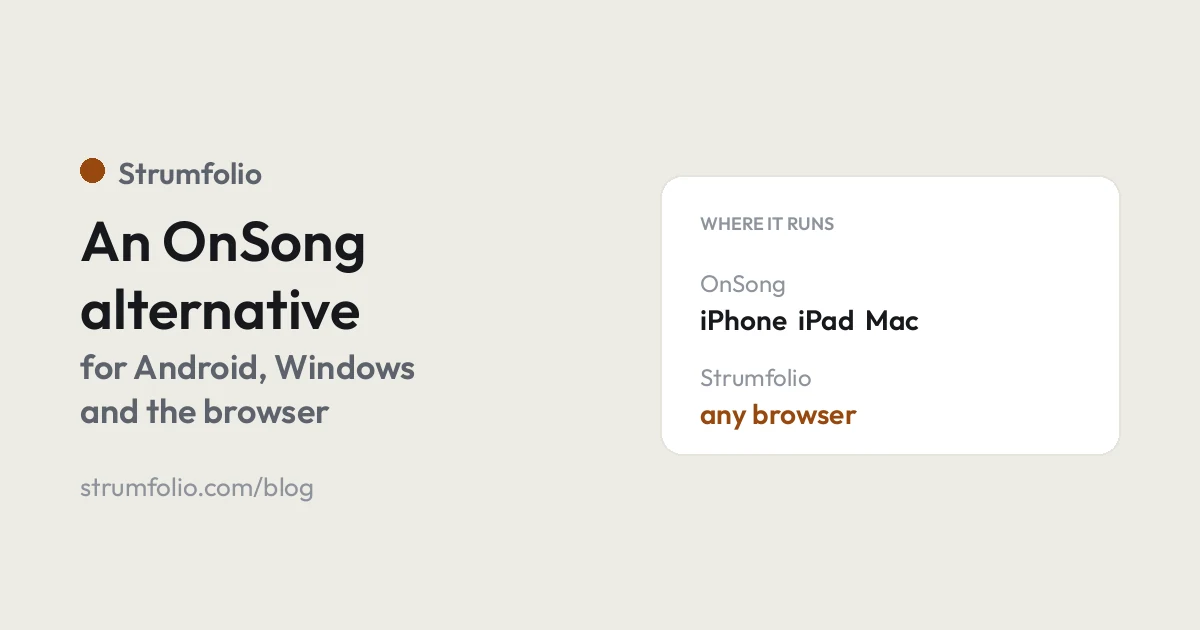
Most people who go looking for an OnSong alternative are not unhappy with OnSong. They are standing in a rehearsal room where one person has an iPad, the singer has a Pixel, and the app that runs the evening only exists on one of those.
What OnSong does well
Worth saying plainly, because it is a lot. OnSong reads text chord charts and PDFs, transposes and capos them, and lets you draw on the page. It scrolls hands-free, takes wireless foot pedals, plays backing and click tracks, sends MIDI, and projects lyrics to a second screen. The 2026 release added ChordFlow, which finds the chords inside a PDF and makes them transposable on the device — a genuinely hard problem, solved well.
It is free to download and build a library in. Paid tiers start at $29.99 a year for Essentials (two devices) and $59.99 a year for Premium (four devices, plus annotations, tracks, MIDI and projection). Prices as listed in September 2026; check the current ones before deciding.
If you are on an iPad and your charts are PDFs, that combination is hard to beat and this article is not going to try.
The thing that sends people looking
OnSong runs on iPhone, iPad and Mac. iOS 15 or later, macOS 11 or later. There is no Android version and no web version — the OnSong Console runs in a browser, but it is for managing the library, not for reading from on stage.
For one player that is a non-issue. For a band it is the whole issue: the moment somebody's phone is not an iPhone, "we all use the same app" stops being available.
What changes when it is a browser
Strumfolio is a web app. The same address opens on an iPad, a Pixel, a Windows laptop and a ten-year-old tablet somebody found in a drawer. Add it to the home screen and it opens like an app, full screen, no store account involved.
Offline is a real mode rather than a fallback: once a song has been opened it stays readable with no signal, which is what a rehearsal room in a basement actually needs.
The free plan is a real plan with no end date — one songbook, thirty songs — so a band can find out whether this works for them before anybody pays for anything.
Everyone reads the same song without everyone buying anything
Strum Together is a link. Whoever is leading shares it; anyone who opens it follows the same song in the same key, from their own screen, automatically. No account, no install, no store, no platform. A guest singer who arrived ten minutes ago can be reading along before the count-in.
Starting a session is on the paid plans. Following one is free for whoever opens the link, which is the half that matters when the room is full of devices you do not control.
Four ways to name the same chord
The same chord has different names depending on who learned music where. Strumfolio reads
international (A, Bb), Italian (La,
Sib), German — where H is B and B is B flat — and
Nashville numbers, which name each chord by its degree of the key.
It is a per-reader setting, not a per-song one. The same sheet can be read in numbers by the session player and in Italian by the singer, at the same time, in the same room.
Moving a library across
This is where an import usually goes wrong, and it goes wrong quietly.
The same ChordPro directive means different things in different apps. {a: …} is the artist in
OnSong and the album in MobileSheets. {st: …} is a subtitle in the ChordPro specification and
was redefined by OnSong to mean the artist. {book: …} names the songbook in OnSong and is an
alias for the album elsewhere. Read with the wrong table, each of those files a correct value
under the wrong heading — and a wrong value that arrived quietly is worse than a missing one,
because nothing ever prompts you to look at it again.
Strumfolio sniffs which app wrote a file before reading its directives, and reads that app's table. When nothing identifies the source, the ambiguous directives are ignored rather than guessed. Everything lands behind a preview that stays editable before it saves, because a conversion is a heuristic and will not always be right.
And it goes back out again: ChordPro in, ChordPro out, nothing held hostage.
When to stay with OnSong
Straightforwardly, if any of these is how you work:
- Your charts are PDFs. Strumfolio reads lyrics and chords as text. It does not read PDF charts at all, and ChordFlow has no equivalent here.
- You annotate. Drawing, sticky notes and clips on the page are OnSong's, not this app's.
- You use a foot pedal, MIDI, or backing and click tracks. None of those exist in Strumfolio.
- You project lyrics to a screen behind the band.
Those are not gaps this app is about to close. If they are your evening, OnSong is the better tool and an iPad is worth owning for it.
When the browser wins
If your library is chords and lyrics rather than PDFs, if the people who need to read it are not all holding the same brand of device, and if you would rather hand somebody a link than ask them to install something — that is the case this app was built for.