

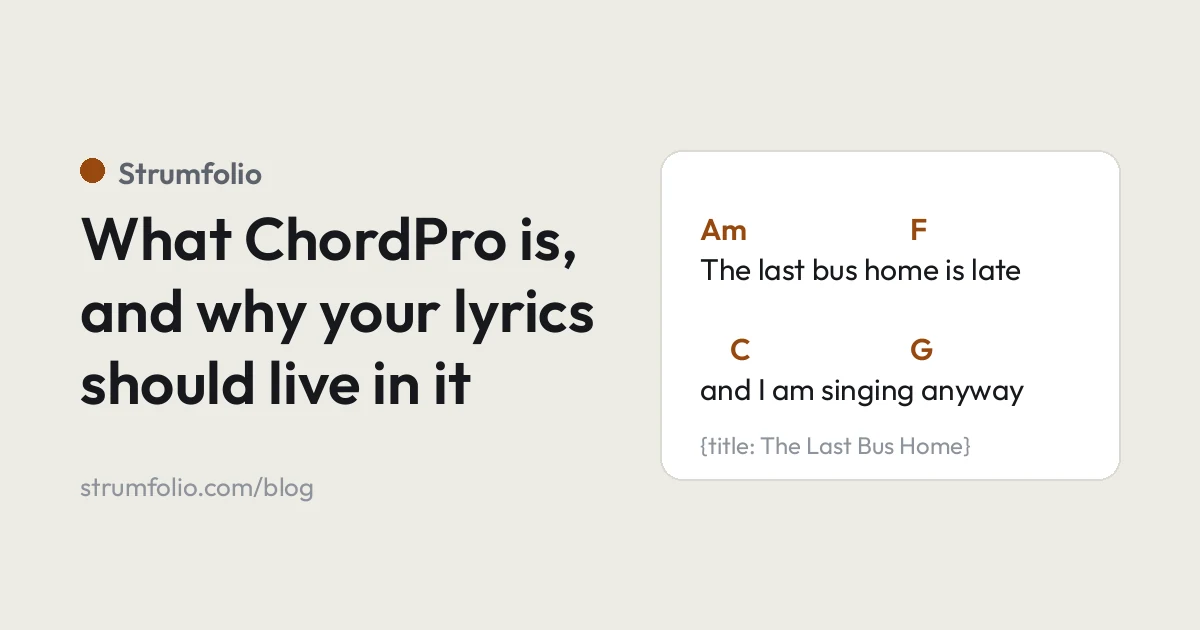
Most people keep their songs in whatever was nearest: a notes app, a screenshot of somebody else's tab, a document where the chords are held above the right syllable by a row of spaces and a prayer. It works until the day the font changes, or the phone does, and every chord slides half a line to the left.
ChordPro is the fix, and it is older than most of the apps that read it. It is a plain-text format — no proprietary file, no account, no export button — in which a chord is written in square brackets, inline, at the exact point in the word where you change your hand.
What it looks like
{title: The Last Bus Home}
{artist: Nina Kovač}
{key: Am}

[Am]The last bus home is [F]late
and I am [C]singing any[G]way
That is the whole idea. The brackets sit inside the line, glued to the syllable they belong
to, so nothing can drift: Am is on "The", F is on "late", and
they stay there whether the line is rendered at twelve points on a phone or forty on a tablet
propped against a music stand.
The lines in curly braces are directives — metadata about the song rather than the song itself. You will meet a handful of them constantly:
{title: …}and{artist: …}— what the song is called and whose it is.{key: …}— the key it is written in, which is what lets an app transpose relative to something instead of guessing.{capo: …}— where the capo goes, if it goes anywhere.{comment: …}— a note to yourself, printed alongside the words.
Anything an app does not understand, it is expected to ignore rather than choke on. That is deliberate, and it is most of why the format has lasted.
Why the brackets beat the spaces
The "chords above the words" layout everybody starts with is not really a format — it is a picture of one. It depends on the text being monospaced, on nobody wrapping a long line, and on every future reader having the same column width you did. Change any of the three and the information is gone, because the information was the alignment.
ChordPro stores the relationship instead of a picture of it. Once a chord is attached to a syllable rather than to a column, an app can do things that are impossible in a screenshot:
- Transpose. Every chord moves by the same interval, and the words do not move at all.
- Apply a capo and show the shapes your hand actually plays, not the ones the recording is in.
- Reflow on a narrow screen without the chords ending up over the wrong word.
- Switch notation, so an Italian musician reads
Lawhere an English one readsA— the same file, two readers.
None of that is clever. It is all downstream of one decision: write down which syllable, not which column.
It outlives the app
The quiet argument for ChordPro is not any feature. It is that the file is readable by a human being with a text editor, twenty years from now, on a device nobody has designed yet. A repertoire is a thing you build slowly and expect to keep; storing it in a format only one company can open is how people lose a decade of work when that company is bought.
If your songs are already in the spaces-and-prayer layout, they are not lost — the conversion is mechanical, and a decent importer will do it for you and show you the result before it saves anything, because the conversion is a heuristic and it will not always guess right.
What matters is where they end up: in a format that will still be a format when the app has changed hands, or names, or gone.