

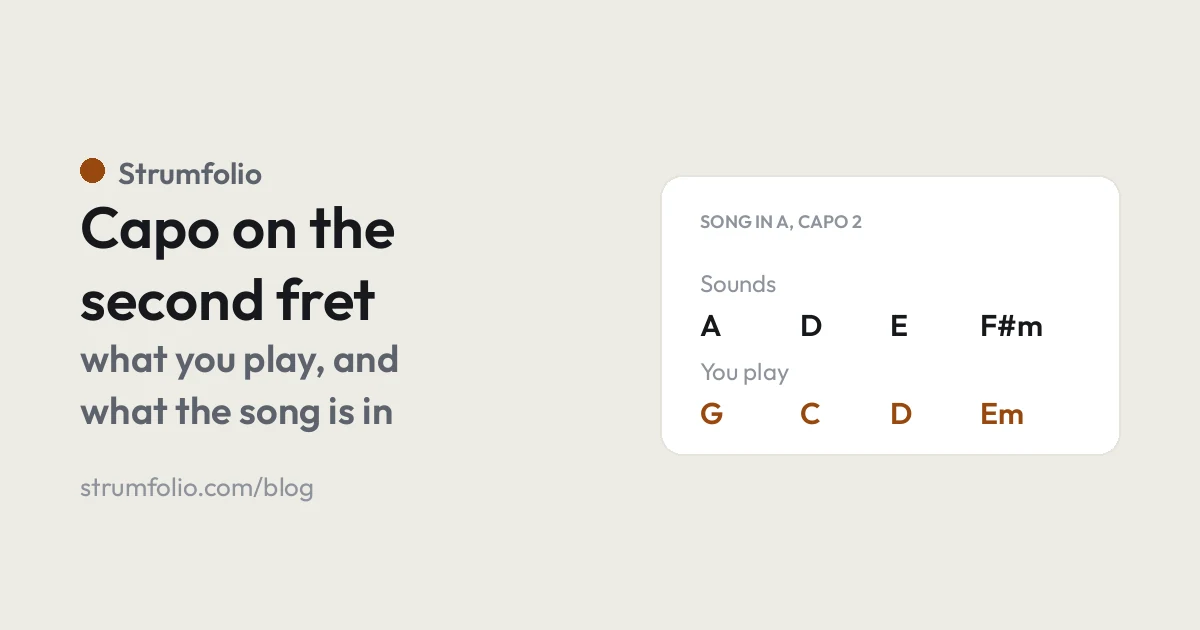
A capo does two things at once, and only one of them is visible. It changes the shapes your left hand holds, and it changes the key everyone else hears. Song sheets usually record one of the two and leave you to work out the other.
Put a capo on the second fret and play what looks like a G chord. Your fingers
are in G. The room hears A. Nothing is wrong with either description, but if the sheet only
says "G" and the singer only knows "A", the two of you are describing the same sound with
different words — and the moment someone else joins with a piano, the disagreement becomes
audible.
Shapes you hold, key you sound
The useful split is to keep both on the page. The key of the song is a fact about the recording: it does not move when you pick up a capo. The shapes are a choice about your hands, and they move every time the capo does.
Song in A, capo 2
Choosing the fret
Every key has a handful of capo positions that leave you with open shapes, and a majority that do not. Working through them by hand means transposing the whole progression once per fret to see which version you can actually play. It is arithmetic, and it is the kind of arithmetic worth handing to the page rather than doing in front of an audience.
That is also why capo and key belong to different controls. Moving the key changes the song for everyone in the room; moving the capo changes only what you read. When the two are separate, a group can share one sheet and each person can set their own fret without touching anyone else's part.
Sharps or flats
One detail is worth settling before you write anything down. Transposing up a semitone from A
gives a chord that can be spelled Bb or A#. They are the same
shape, and the key you are in decides which spelling reads correctly. Keys with flats keep
flats; keys with sharps keep sharps. Mixing them on one page is legible but distracting, and
distraction is the thing a chord sheet exists to remove.