

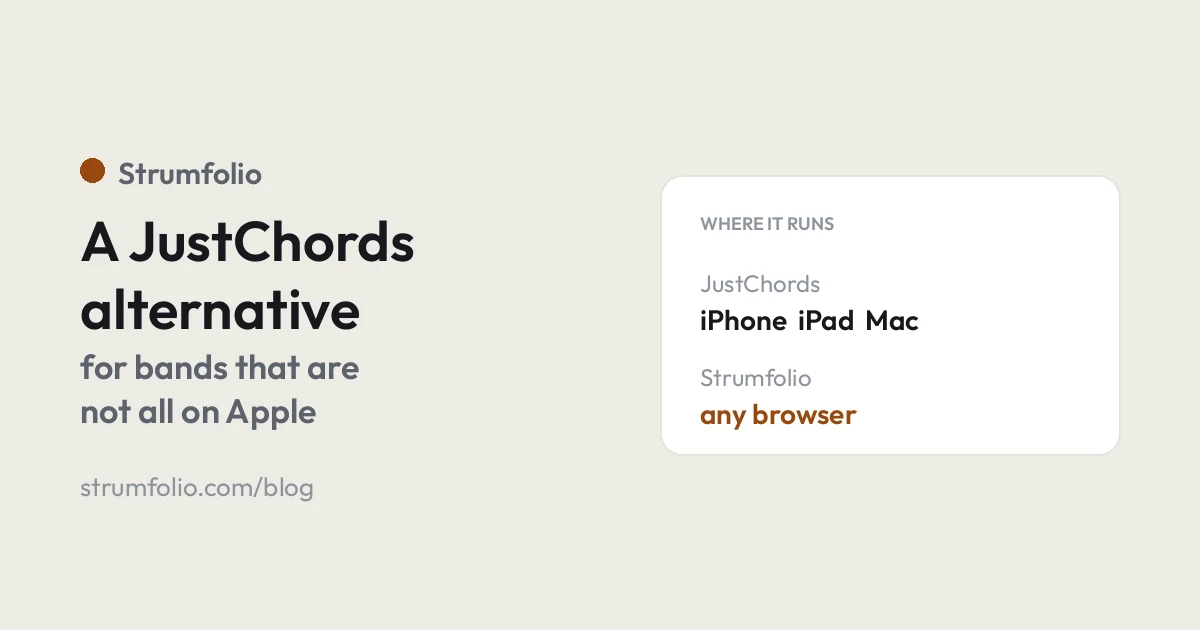
JustChords is the hardest app in this category to argue with. It is deep, it is well made, and it asks for a tip rather than a subscription. If you and everyone you play with are on Apple devices, you should probably just use it — and this article will say so again at the end.
What follows is for the case where that "if" does not hold.
What JustChords does well
The feature list is long and most of it is genuinely useful on stage. Transpose, capo, and rewrite a song into a different key outright. Setlists you can share. Autoscroll at tempo. A metronome and a tuner. Chord diagrams for guitar, ukulele and piano, with buttons that play a chord so you can hear what you are about to read. Audio tracks attached from Spotify, Apple Music or a URL. Bluetooth and MIDI pedals for hands-free page turns. AUv3, so it runs as a plugin inside Logic Pro and GarageBand. ABC notation for sheet music. AirPlay to project lyrics. Annotations, cues, highlights. Real-time collaborative setlists — PlayTogether — that keep a band in step.
And it is free, with optional in-app purchases that exist mostly to say thank you rather than to unlock things. That is an unusually generous way to sell software and it deserves to be said out loud.
The thing that sends people looking
iPhone, iPad and Mac. That is the whole list. There is no Android build and no web version.
PlayTogether keeps a band's setlists in sync in real time — but everyone in that band needs JustChords, which means everyone needs an Apple device. It is a fine answer for a band that already has one; it is not an answer for the guitarist whose phone is a Samsung.
That is the shape of the problem worth being clear about before shopping for a replacement. It is not a missing feature, it is a missing platform, and no amount of quality on the other side of the fence helps the person standing on this one.
What changes when it is a browser
Strumfolio opens at a URL. iPad, Android tablet, Windows laptop, an old phone with a cracked screen — if it has a browser, it has the app. Add it to the home screen and it runs full screen. Once you have opened it with a signal while signed in, it saves your whole repertoire to the device and keeps working with no connection.
The free plan holds a real repertoire with no time limit: one songbook, thirty songs. Paid plans lift the caps and add ukulele shapes and a printed booklet. The wider round-up puts both of these next to the rest of the field, if you are still deciding which corner you are shopping in.
Following needs nothing at all
This is the sharpest difference, and it is worth being precise about rather than waving at.
PlayTogether syncs setlists between people who have the app. Strum Together shares a link. Whoever opens it follows the same song in the same key, live, from their own screen, with no account, no install and no copy of your library. The people following do not need Strumfolio in any sense — they need a browser.
That makes it a different tool for a different moment: not "my band and I stay in step", but "everyone in this room, including people I met tonight, is reading what I am playing". If you play alone more often than not, that difference is most of the case for a solo performer.
Starting a session is on every plan, the free one included — one other screen there, the same on Standard, more on Plus and Premium. Following is free, always, for anyone.
Reading the same sheet in four alphabets
International, Italian, German — where H is B and B is B flat — and
Nashville numbers, which name each chord by its degree of the key rather than by a letter. Chosen
per reader rather than per song, so a session player can read their charts in numbers while a
singer reads theirs in La; in a Strum Together session everyone follows the
leader's choice.
Every fingering in the app's own library is checked against the notes that make the chord, a fingering a file defines for itself is drawn as written, and a chord the app has no shape for shows its notes instead of a guess — the reasoning behind that is a short read and explains why a lookup table always runs out eventually.
Getting your songs in
Whatever you are moving from, the door is the same: ChordPro text in, ChordPro text out. If your sheets are the older layout — chord names on a line above the words — the free converter turns them into it in one paste, and everything lands behind a preview that stays editable before it saves.
When to stay with JustChords
Most of the time, if you are on Apple. Specifically:
- You want the deepest feature set for the price of a tip. Strumfolio's caps and some of its best parts are on paid plans; JustChords' are not.
- You need a tuner in the same app. Strumfolio has a metronome now — tempo, accent, and a beat you can see as well as hear, which matters on a phone carried on silent — but its tuner is still a separate app on another address.
- You use MIDI, pedals, audio tracks, AUv3, or AirPlay projection. None of those exist here.
- You read sheet music. Strumfolio keeps an ABC block from a ChordPro file as its source text and never draws it as music — it is a lyrics-and-chords app and nothing else.
That is a serious list, and pretending otherwise would not help anybody choose.
When the browser wins
One case, but it is a common one: the people who need to read your songs are not all on Apple, or are not all people you can ask to install anything. If that is your rehearsal room, this is what that room can actually use.
Questions people ask
- Is JustChords available on Android?
- No — the platform list is iPhone, iPad and Mac, with no Android build and no web version. For a mixed band the practical substitute is a chord app that runs in the browser, since that is the one thing every phone, tablet and laptop in the room already has.
- Is there a free JustChords alternative?
- Strumfolio has a free plan with no time limit — one songbook and thirty songs, enough for a real working set. It is worth being straight about the comparison though: JustChords is free with optional tips and gates almost nothing, while here the caps and some of the best parts sit on paid plans. If price is the deciding factor and you are on Apple hardware, JustChords wins that argument.
- Can a band read along if not everybody has the same app?
- Yes — that is what a shared link does: whoever is leading shares one, and anyone who opens it follows the song being played in the same key from their own screen, with no account, no install and no copy of the library. Every plan can start a session, the free one included, with one other screen following, the same on Standard; Plus and Premium raise that number. Following one is free for whoever opens the link.
- What does Strumfolio not do that JustChords does?
- A tuner, MIDI and pedal control, audio tracks, running as a plugin inside a DAW, projecting lyrics over AirPlay, and sheet music in ABC notation. A metronome used to head that list and no longer does: it is in the reading bar, and a song that carries its own tempo in ChordPro starts there. Of what is left, none is planned as a side effect of anything else — so if your evening depends on one of them, the honest answer is that this is not the app for it.